

The current global landscape is marked by significant economic, energy, and geopolitical uncertainty, leading many organizations to prioritize short-term decisions. In this environment, sustainability can no longer be viewed solely as a matter of reputation or compliance, but as a business capability directly linked to resilience and competitiveness.
The energy transition is no longer just a climate objective; it has also become a key factor in autonomy, stability, and operational continuity. While current challenges are reshaping priorities, the underlying goal remains the same: building organizations capable of adapting to a more sustainable and efficient economic model.
1. The Illusion of the Risk Map
The recent Global Risks Report 2026 from the World Economic Forum (WEF) highlights a notable shift in short-term business concerns. Over the next two years, risks related to geoeconomic confrontation and critical infrastructure instability have gained prominence over climate-related risks.
However, the picture changes when we shift to a longer-term view. The most significant global risks remain closely tied to environmental and climate issues, reinforcing the idea that sustainability continues to be a structural factor for business continuity.
Sustainability is evolving toward a more pragmatic approach, one that is closely connected to an organization’s ability to anticipate risks, secure access to strategic resources, and operate efficiently in a rapidly changing environment.
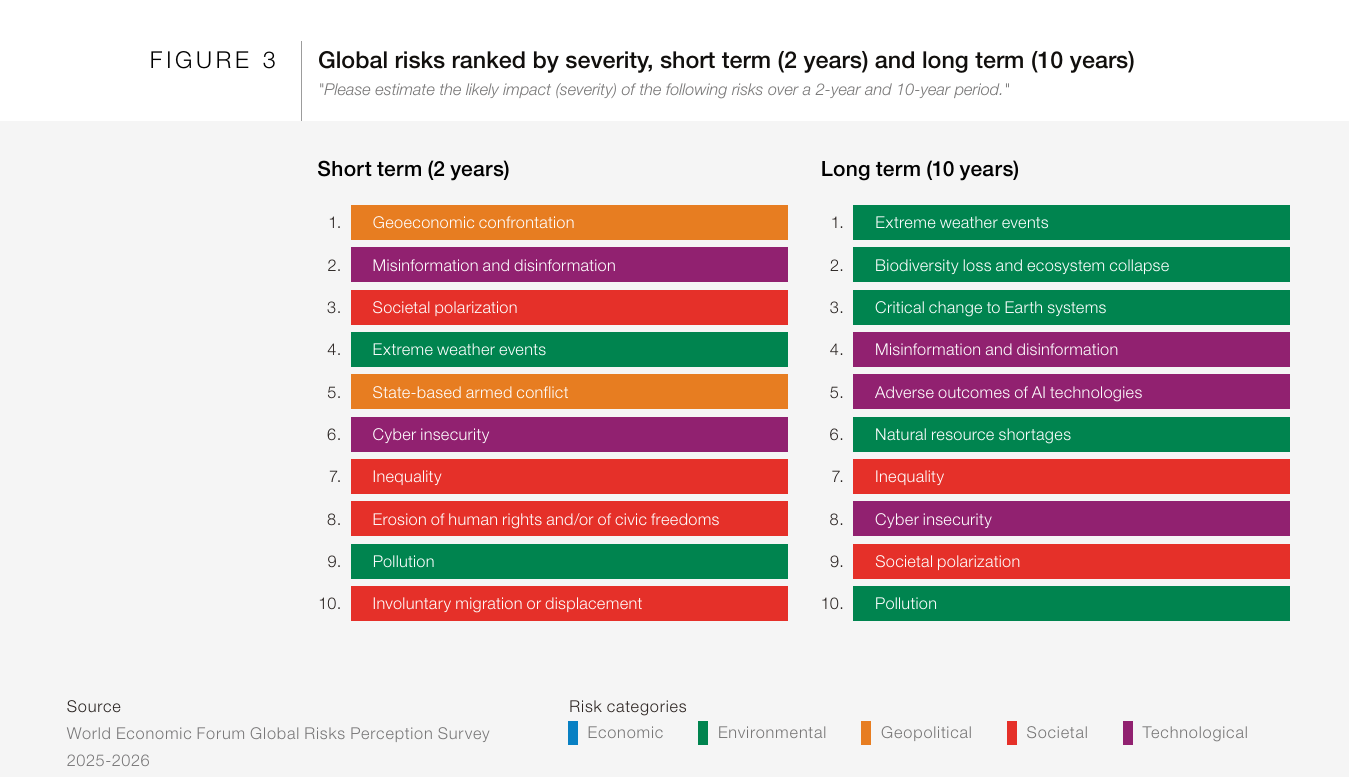 Link : The Global Risks Report 2026 | World Economic Forum
2. Europe’s Shift: “Less Is More”
Europe has responded to industry concerns over declining competitiveness. The Omnibus I simplification package (February 2026) and the postponement of the CSDDD implementation until 2029 are clear signs of this more pragmatic approach. But make no mistake: Less administrative pressure does not mean fewer obligations.
The EU has moved from a model of “reporting for the sake of reporting” to one of “reporting to transform”.
-
Operational Simplification: Redundant metrics have been removed, and reporting thresholds under the CSRD have been raised, giving companies greater flexibility.
-
Selective Mandatory Requirements: What remains within the regulatory framework is now Hard Law. The process has been simplified, but the substance has become more demanding. The challenge is no longer producing a 300-page report; it is demonstrating, with auditable data, that your organization can operate successfully in a low-carbon world.
3. Data as an Asset, AI as the Engine
If the short term is shaped by geopolitics and the long term by sustainability, technology is the bridge between the two. In 2026, ESG data has evolved from a compliance metric into a strategic business asset.
-
AI as a Resilience Shield: In an increasingly fragmented environment, leading organizations are using AI to map dependencies in real time. The goal is no longer just understanding a supplier’s carbon footprint, but anticipating whether that supplier can withstand future resource shortages or new CBAM-related tariffs.
-
From Reporting to Action: Thanks to generative AI and advanced analytics, the cost of processing sustainability information has fallen by 40% this year. This enables organizations to move from static annual reporting to real-time impact management. AI becomes the engine that helps companies meet increasingly demanding requirements around data quality and traceability without overburdening their operating models.
In this context, data, analytical, and AI capabilities will be critical to transforming sustainability into a true management capability. At SDG, we work with organizations to accelerate this transition, helping them build more automated, traceable, and decision-oriented ESG models.
Conclusion: Don’t Let the Noise Obscure the Horizon
The message for 2026 is clear: Use the reduction in bureaucratic pressure to strengthen your data foundation. The postponement of the CSDDD and the simplification of the CSRD are not regulatory holidays; they are a window of opportunity for organizations to embed sustainability into their technological core.
Companies that use this breathing room to automate data collection and strengthen their strategy with AI will not only be better prepared to navigate short-term uncertainty, but also to address the major structural challenges that will define the next decade.
Because in 2026, sustainability can no longer be understood solely as an environmental commitment. Above all, it must be viewed as an exercise in business resilience in a world of constant disruption.
Sustainability Domain Leader SDG Group Spain