How Qlik AutoML takes predictive analytics beyond the boundaries of traditional machine learning, making it accessible to everyone.
Welcome to Tech Station, SDG Group’s hub for uncovering the latest innovations in data and analytics! In this article, we explore Qlik AutoML, a tool that democratizes machine learning, allowing business users to create, understand, and act on predictive models without technical complexity. Discover how this solution shifts the focus from retrospective analysis to proactive decision-making, transforming historical data into a strategic guide for the future.
Looking for something else? Check all of our content here.

In today’s work environment, focusing on the technical complexity of developing models for decision-making can become a limitation, taking away time and resources that could instead be devoted to the actual analysis.
In this context, Qlik AutoML comes to the rescue by enabling the application of data science to everyday problems in a simple and efficient way. It offers machine learning models and predictive analytics through an intuitive and straightforward experience that leverages artificial intelligence to enhance human decision-making capabilities.
In this article, we will analyze what it consists of and, through a case study, understand how its features ensure the reliability and performance of the models, thereby improving the effectiveness of decision-making processes.
What is Qlik AutoML?
Qlik AutoML transforms AI into actionable value by enabling organizations to shift from retrospective analysis to proactively driving future outcomes.
It not only creates models that predict future trends by analyzing historical data but also helps explain those predictions.
In fact, it is not a “black box” system: the “compare” page shows the overall performance of the various models tested, while the “analyze” page reveals which information was most useful in generating the predictions. Finally, Qlik AutoML enables action based on those predictions, offering interactive tools to test different scenarios and assess their potential impact on the business.
Qlik AutoML focuses on three main areas:
- Predict: Qlik AutoML takes your historical data and creates models to forecast future trends, requiring no code. You simply provide your data, and Qlik AutoML takes care of generating reliable predictions.
- Explain: As previously mentioned, users have access to both the compare page, which displays the overall performance of the different models tested, and the analyze page, which dives deeper into individual models to identify the most important information used in generating predictions. This transparency helps build trust in the predictions and allows you to explain the underlying reasoning to your team and stakeholders.
- Act: Qlik AutoML allows you to easily integrate insights into existing Qlik analytics applications and daily operations. It is also possible to set up alerts to notify your team when changes in key metrics are predicted, enabling proactive intervention.
Below, we can see the Qlik AutoML workflow:
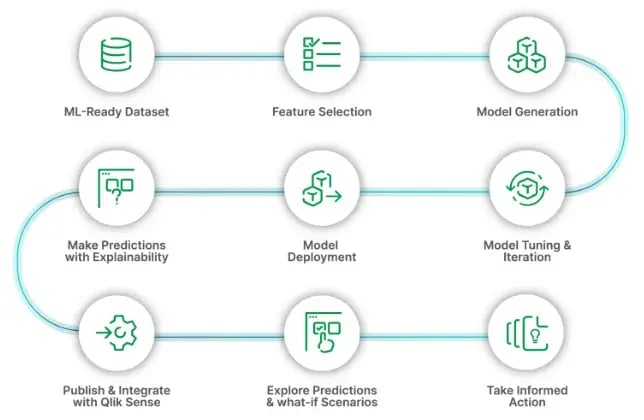
Qlik AutoML workflow
After connecting to the data source and preparing the dataset, it is necessary to define the outcome to be predicted or the problem to be solved.
After that, the model is automatically created and optimized, and it will then be used to generate the prediction.
Once the key factors influencing the prediction are identified, it becomes possible to make the best decision based on one’s specific objective.
One of the many advantages of using Qlik AutoML is precisely the ability to obtain models and predictions without writing a single line of code, thereby expanding the audience capable of using it.
As mentioned, it also clearly explains how these predictions are made, and it is possible to integrate the insights into daily operations and existing Qlik analytics applications, as well as to test different scenarios and understand their potential impact on the business.
A Real-World Example
Below, we present an example of a predictive problem aimed at detecting fraudulent transactions, based on historical data such as transaction amount, the time of occurrence, the frequency of operations, etc.
For the training phase, it was sufficient to download the dataset containing the historical data, define the variable to predict — in this case, fraud (indicated by the binary class 0/1) — and select the most relevant features, then run the model.
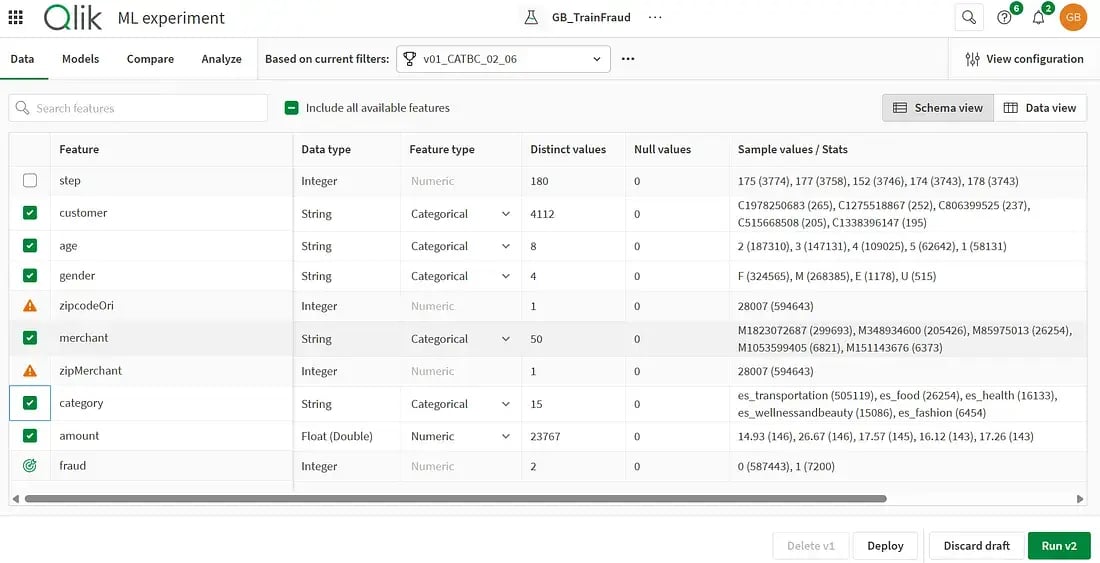
Within the Models section, it is possible to identify which of the tested models has the best performance and to see the contribution of the individual features to the prediction.
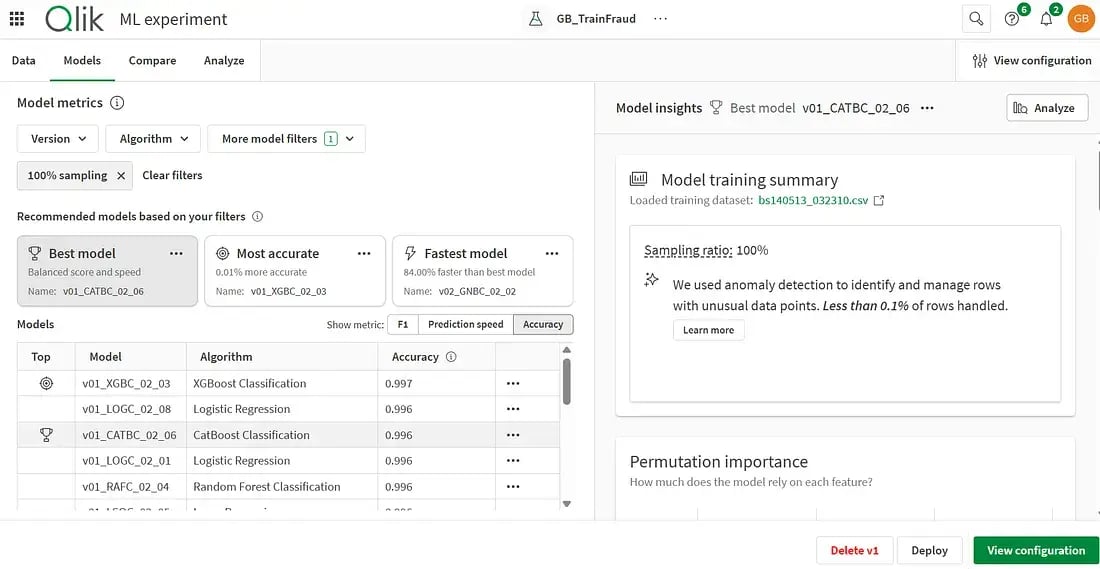
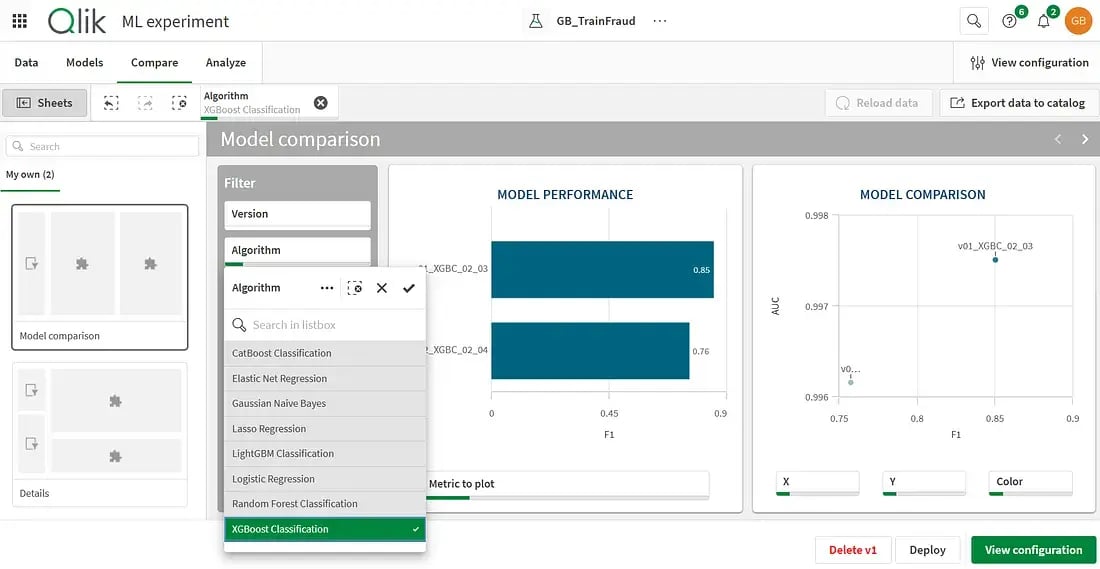
In the Compare section, you can compare models and apply filters to make the analysis as precise and personalized as possible, enabling users to contrast specific algorithms tested.
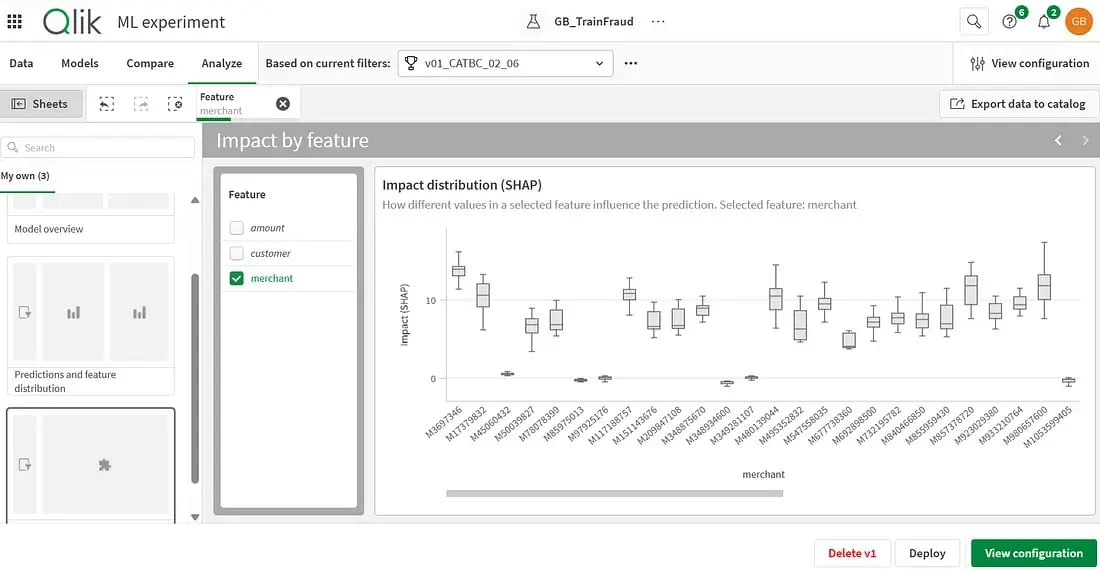
Finally, as we can see from the following image, it is possible to perform an exploratory analysis through charts that update based on the filters related to the features:
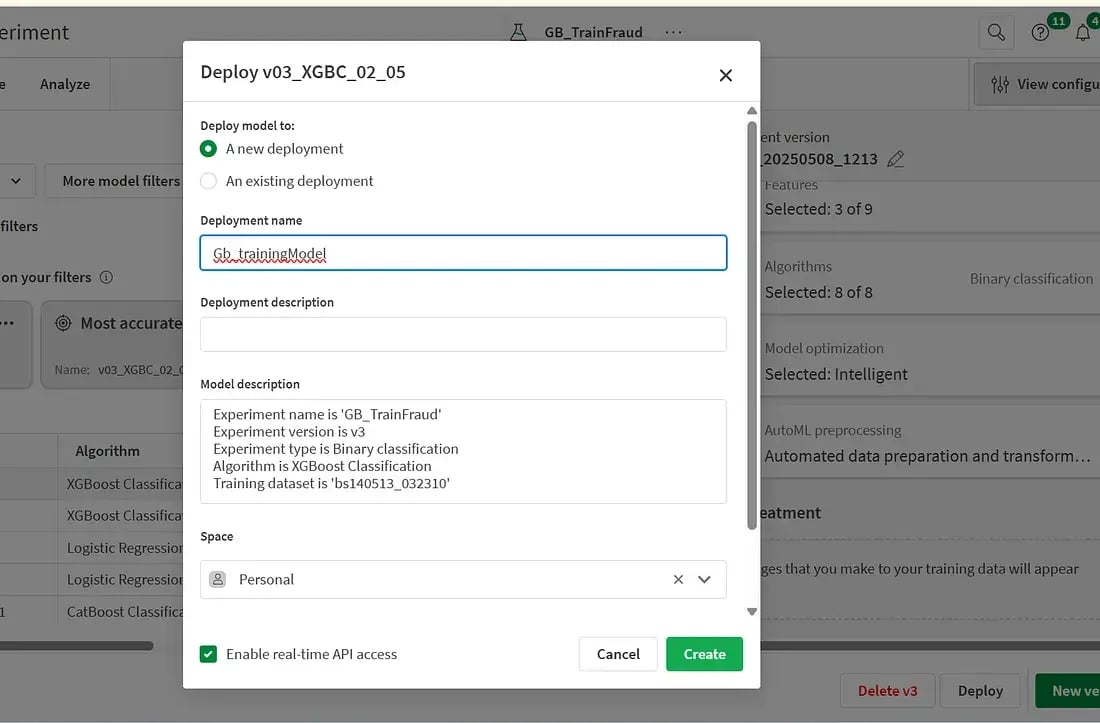
Once the training part is completed according to your needs, simply press the ‘DEPLOY’ button and save the model.
Therefore, now we are ready for the testing phase by simply uploading the desired dataset to create a new prediction.
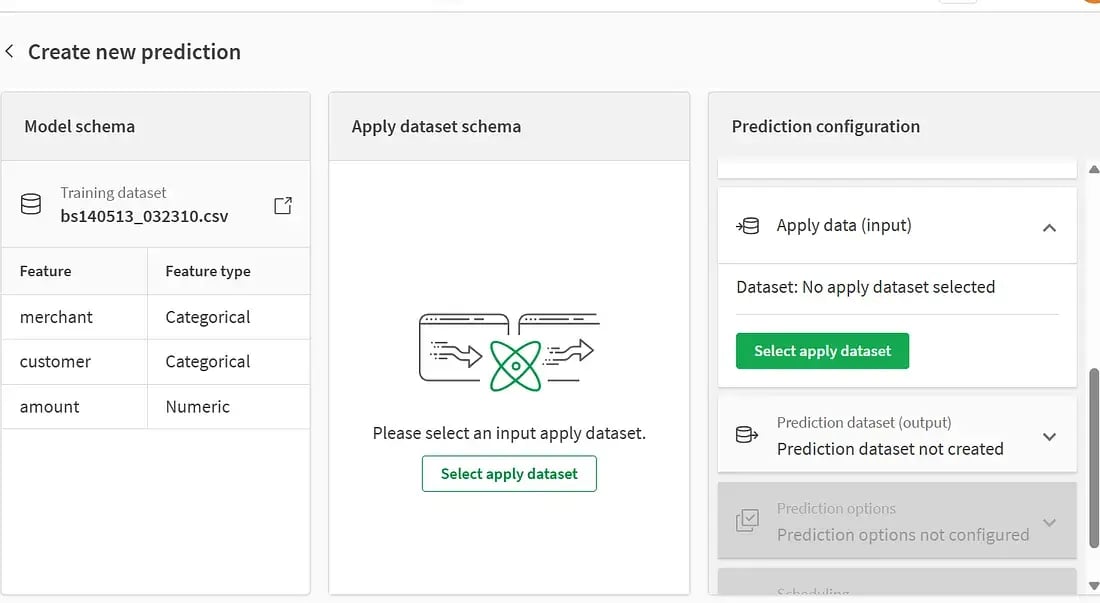
Testing phase
Qlik AutoML Across All Business Areas
Thanks to its high flexibility, the power of Qlik AutoML can be leveraged across multiple business domains:
-
Marketing and Finance: it enables the adaptation of offers based on customer value, the adjustment of launch plans, and the rebalancing of investment portfolio allocations.
-
Operations and Sales: it allows for preventive maintenance scheduling of equipment and, for example, prioritization of high-potential sales leads, balancing sales targets by region.
-
Human Resources: it supports the implementation of targeted employee retention programs and the definition of personnel selection criteria, enabling proactive hiring strategies.
-
Supply Chain: it delivers significant benefits by strategically planning material procurement, tracking efficient delivery routes, and reorganizing inventory optimally.
Conclusion
Qlik AutoML therefore proves to be an effective and versatile resource across multiple business domains, allowing for a reduction in the technical complexity and resource expenditure typically associated with the development of machine learning models.
However, its value lies not only in the creation of such models, but above all in the transparency of predictive analysis and the identification of key drivers, which enable a deep understanding of the results and a focus on the decision-making process itself, enhancing it with predictive insights.
It proves to be an essential tool in addressing the growing challenges faced by companies and researchers, easily transforming historical data into a driving force for a proactive business.
Ready to integrate predictive analytics into your decision-making process, without writing code? Contact us for a personalized consultation and discover how Qlik AutoML can empower your teams, transforming historical data into strategic and proactive insights to guide the future of your business.

.jpg?width=631&height=631&length=631&name=Cover%20tech%20station%2011%20(1).jpg)