.jpg?width=631&height=631&name=01_Bannersweb_1200x1200%20(Main%20one).jpg)
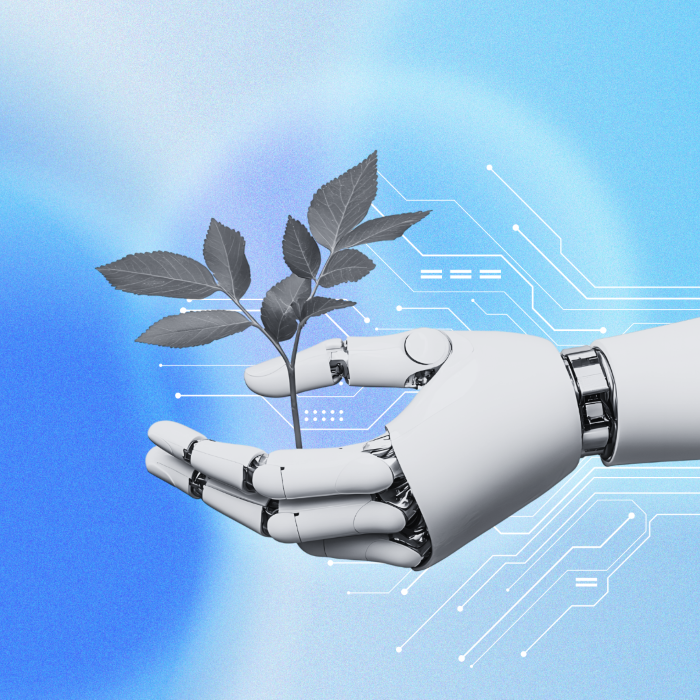
The next frontier of enterprise transformation isn’t found on a screen. It’s found in the fusion of neural networks and physical systems, redefining customer engagement and operational resilience through the emergence of Physical AI.
For decades, Artificial Intelligence existed in a digital vacuum (processing data, predicting patterns, and generating content within the confines of a "sandbox"). Today, we are witnessing a tectonic shift: the transition from Generative AI to Physical AI. By embedding large-scale foundational models into machines that perceive, reason, and act, we are giving AI a "body," enabling it to navigate the complexities of the material world.
Beyond the Screen: The Convergence of Intelligence and Physics
The disruption triggered by GPT models – particularly the release of GPT-3.5 in 2022 by the company OpenAI – reshaped how artificial intelligence was understood and applied. The rise of AI agents, such as customer service bots, followed quickly.
Since then, AI has transformed the economy in remarkable ways,in particular thanks to Generative AI, the most visible form, which can create text, images, video and audio from training data and has rapidly become a staple of business operations.
The explosion of Large Language Models (LLMs) proved that AI could master human language. However, the real-world environment is governed by physics, not just syntax. Physical AI—often called Embodied AI—represents the integration of three critical pillars: Multimodal Perception, Foundation Models for Reasoning, and Real-world Interaction.
Now, significant developments are underway to embody AI in tangible systems, this approach is increasingly being seen by industry experts as the next frontier in customer service and operational efficiency.
By combining perception, learning and motor skills, these systems can link analysis directly to action. Unlike a chatbot that merely responds to prompts, Embedded AI can sense its surroundings and make decisions that have physical or simulated consequences.
.jpg?width=453&height=606&name=02_Bannersweb_860x1105%20(1).jpg) Crossing the Uncanny Valley with Purposeful Design
Crossing the Uncanny Valley with Purposeful Design
The challenge of giving AI a physical form is not new. In 1970, the robotics expert Masahiro Mori introduced the concept of the “uncanny valley”, suggesting that as machines become more human-like, they can provoke discomfort or rejection once they appear almost, but not quite, like a real person.
While early robotics experiments warned of the uncanny valley, today’s AI systems are learning to combine physical realism with approachable design, paving the way for broader adoption. Instead of chasing hyper-realism, the new era of Physical AI focuses on Empathetic Utility.
Robots are now being designed to interact through a physical body, using sensors and movement rather than text or a screen. According to our latest Innovation Radar report, the key to this trend is the integration of three elements: advanced reasoning, motor capabilities and sensory perception.
The integration of AI with the physical world is evolving into AI that can act directly through its generative capabilities. This is already happening: wearables are increasingly incorporating AI, and some devices are even built entirely around it. In the business world, we can start with more realistic expectations: AI-enabled bank tellers represent the next step beyond publicly available chatbots.
What happens, then, when a machine meets AI? Thanks to this combination of capabilities, Physical AI is paving the way for countless technological solutions, many of which can help companies improve their customer service.
Imagine, for example, robots that welcome new guests at a hotel, assistants that guide new employees during orientation, or avatars helping customers in a shopping centre.
Jensen Huang, the founder and CEO of US technology company NVIDIA, predicts that within 10 years robots will have capabilities that will surprise even the biggest sceptics. He imagines a world where digital agents seamlessly execute complex tasks, and physical AI systems fundamentally reshape our interactions with the real world.
The Strategic Roadmap: GenAI → Agentic AI → Physical AI
To understand where the market is headed, we must view it as an evolutionary continuum:
- Generative AI: Focuses on content creation and knowledge retrieval.
- Agentic AI: Focuses on autonomous decision-making and digital task execution.
- Physical AI: The ultimate stage, where autonomous agents interact with and manipulate their physical surroundings.
This evolution is already manifesting in AI wearables and Human-Machine Interfaces (HMI) that don't just display data but understand context. In the corporate world, this translates to "Physical Tellers" and "Smart Avatars" that offer a level of presence and reliability that traditional interfaces simply cannot match.
AI’s growing role in business
AI is already deeply embedded in business operations, from analytics to automation. More natural language interfaces, which are rapidly improving, are set to make interaction with machines feel smoother and more intuitive, particularly in sales and customer-facing roles.
Making machines feel non-threatening remains a significant challenge, as initial reactions to autonomous systems often include rejection. Yet humans have long coexisted with machines, and familiarity is growing: robot dogs, automated warehouse helpers and domestic assistants are increasingly common, gradually normalising everyday interactions with Physical AI.
The next stage is voice control. Asking a robotic arm to prepare a meal, such as a salad, for instance, may soon be less science fiction and more our new reality. This shift will reflect the convergence of two previously separate fields: artificial intelligence and robotics.
Industrial Metamorphosis: Digital Twins and Omniverse-Scale Training
The shift from digital to physical intelligence requires a fundamental change in how models learn. Unlike Large Language Models (LLMs) that ingest massive internet datasets, Physical AI must be grounded in the laws of physics. These systems must remain safe and generalized for dynamic, real-world scenarios, operating with real-time perception and reasoning.
However, collecting enough real-world data to cover every possible edge case is often dangerous, costly, or logistically impossible. This is where Physically Based Synthetic Data Generation becomes the "X-factor." By utilizing high-fidelity Digital Twins (virtual replicas of real machines and environments) models can be trained at scale in simulated worlds that perfectly mimic the physical one. This "Simulation-to-Reality" (Sim2Real) pipeline allows Physical AI to master complex tasks, such as precision food prep or collaborative assembly, in a safe, accelerated, and highly optimized environment before ever being deployed on a physical floor. Models can be trained on operational data to improve quality control or precision tasks, enabling continuous optimization, increasing productivity and reducing errors.
Physical AI is likely to spread across manufacturing, automotive production, construction and food services. Examples include humanoid robots on assembly lines, autonomous warehouse systems and “cobots” – collaborative robots – in food preparation.
In the hospitality sector, restaurants, hotels and service stations are experimenting with intelligent robots that provide information, assist staff and speed up routine tasks such as room cleaning. In logistics, automated systems already work alongside humans, moving goods and managing inventories. And in manufacturing, AI-equipped robots handle packaging inspection, welding and component assembly.
As AI steps into the physical world, the line between digital intelligence and reality is already blurring – promising new ways to work, shop and connect that were once the realm of science fiction.
Conclusion: The Blurring of Digital and Material Realities
Physical AI is more than a trend; it is the "closing of the loop" between digital intelligence and physical execution. As we embed reasoning into the fabric of our physical infrastructure, the distinction between "online" and "offline" service will vanish.
For forward-thinking organizations, the challenge is no longer just "How do we use AI to think?" but "How do we use AI to move?" The companies that master this physical presence will be the ones to define the next decade of customer experience and industrial efficiency.
Explore the full Orbitae Portfolio of Services and discover how our end-to-end services and solutions can help your organization accelerate transformation, reduce risks, and maximize value.



-1.png)
.png)
-2.png)