

Every time a board meets to discuss strategy, there's an uncomfortable truth everyone ignores: critical business decisions are being made using weeks-old data. Meanwhile, as markets move instantly, Finance teams are stuck manually copying and pasting across dozens of spreadsheets.
Let's look at how to break out of these outdated workflows—and why legacy tools can no longer build the data foundation needed to turn numbers from a compliance chore into a real strategic engine.
The Strategic Disconnect
Market conditions change overnight and supply chains remain completely unpredictable. Competitive pressures hit hard across every industry. Yet, most companies still plan their future using tools and processes built for a far more stable world.
It’s a massive mismatch. Executive teams want instant, accurate insights to model different futures in real time. Meanwhile, Finance and Operations teams are stuck dealing with fragmented systems, manual workarounds, and rigid planning cycles.
This creates a widening gap between what leadership needs and what the planning process actually delivers. This isn't just an operational headache—it's a massive drag on corporate strategy.
The Limitations of Legacy Planning
Old-school planning tools just can’t keep up anymore. They rely heavily on disconnected spreadsheets and siloed systems, which slows down operations and introduces constant errors. Teams waste days gathering, validating, and stitching data together from multiple sources. It’s a slow, fragile process.
The biggest hidden time-sink in legacy planning is mismatched terminology. Different departments use completely different definitions, codes, and naming conventions for the exact same metrics. Hours are wasted arguing over data tables before planning can even begin.
This fragmentation ruins everything downstream. By the time numbers are consolidated, they are already outdated. Quick scenarios cannot be run, nor can new risks be assessed, as the baseline remains in flux. Instead of proactive business steering, organizations are left playing catch-up.
In the real world, this lag results in slower responses to market shifts, missed growth opportunities, and significant inefficiencies that hinder performance. Continuous business operations cannot be sustained with periodic, fragmented planning.
Redefining the Planning Model
To address this gap, planning processes require a fundamental shift.
Continuous planning is essential. Static annual budgets are increasingly ineffective; modern finance functions utilize dynamic processes that update forecasts in response to new data. Such an approach ensures agility as conditions evolve.
Furthermore, financial targets must be directly aligned with operational execution. A lack of coordination between operations and finance renders strategic plans ineffective.
This is where AI and predictive analytics change the game. Instead of manually looking backward at past performance, machine learning highlights trends early and improves forecasting accuracy. Rather than serving as a minor upgrade, this transition transforms the planning process from a corporate bottleneck into a strategic advantage.
The OneStream Advantage
This is exactly where OneStream fits in. It replaces fragmented tools with a single unified platform and data model, bringing financial and operational data together into one source of truth.
With OneStream, you get built-in data integration, deep financial intelligence, agile analytics, and embedded AI that actually scales with your business needs. Closing cycles are reduced, and accurate forecasting, reporting, and analytics are provided within a single environment.
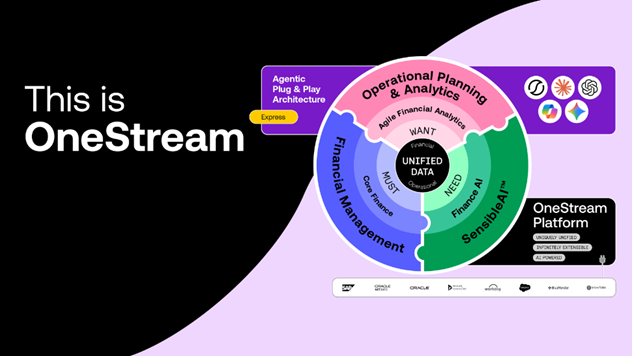
With OneStream, you accelerate monthly closes, plan with confidence, and gain reporting, forecasting, and analytics in a single software environment.
OneStream builds AI directly into the platform's daily workflows. These aren't generic AI tools—the SensibleAI solutions are built specifically for corporate finance, focusing entirely on trust, transparency, and accuracy. It’s the only enterprise Finance platform that unifies all data, embeds native AI, and completely adapts to your specific setup.
But a great software platform needs the right architecture underneath to actually work. That's where SDG Group comes in.
Turning Strategic Vision into Operational Reality with SDG Group
SDG Group handles the bridge between high-level business strategy and deep technical setup. Complex financial logic is translated into highly optimized, scalable architecture.
Turning software potential into real business value takes a specific mix: hands-on corporate finance expertise, multidimensional database modeling, and optimized data pipelines. Rather than utilizing generic templates, SDG Group develops precise, driver-based planning models engineered specifically for the day-to-day realities of FP&A.
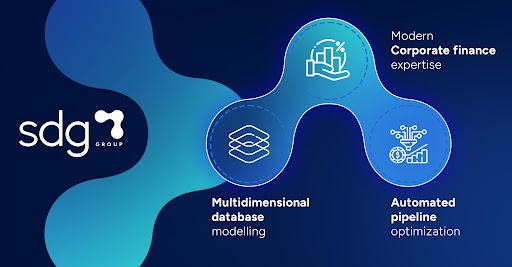
The combination of these three specific skills makes SDG Group an ideal partner for extracting the full potential from OneStream.
Expertise is focused on building clean, governed data foundations, which are essential before predictive forecasting and AI-driven insights can be successfully deployed.
Because advanced capabilities are ineffective without clean data, the entire development lifecycle, from initial data model design through rigorous user acceptance testing (UAT) to post-release support, is managed by SDG Group to eliminate workflow friction and permanently resolve deep-seated master data misalignments.
From Planning to Performance
The real payoff here is the accelerated speed of organizational decision-making. By automating manual data assembly for Finance, the entire enterprise gains a level of agility that transforms planning. Planning stops being a backward-looking administrative chore and becomes a continuous competitive advantage.
Because the numbers are clean and structurally guaranteed, leadership teams can make decisions with absolute confidence. Strategic alignment stops being a buzzword on a slide; it becomes a daily operational reality where corporate goals and actual execution stay permanently synchronized.
This shifts the entire role of the CFO. Modern finance leaders can drop the role of the historical scorekeeper managing siloed spreadsheets. Instead, they become true strategic copilots. With real-time, trusted operational data and forward-looking simulations, CFOs can steer corporate execution through market volatility, turning disruptions into growth opportunities.
Where Technology Meets Expertise
Technology alone won't fix enterprise performance, but you can't modernize without it either. True modernization requires a perfect match between software innovation and execution discipline.
OneStream gives you the engine, the financial intelligence and the single source of truth needed to model different futures. SDG Group provides the strategic architecture and deep financial expertise to turn that software potential into a reliable operational reality.
Want to know more about how to level up your FP&A capabilities? Let’s talk.
-2.png)

-4.png)
-1.jpg)
-4.png)



.png)
-1.png)