

Written by Hunter Johndro, Data Governance & Strategy Leader
We’re at an inflection point in how organizations think about data governance.
On one hand, AI brings more complexity than ever before - large language models, machine learning, algorithmic bias, explainability, and more. On the other hand, AI also gives us smarter tools to actually manage that complexity. It’s a bit of a paradox: AI is both the reason governance needs to evolve and the means to help it do just that.
From my experience working with organizations undergoing digital transformation, this duality is where many data governance strategies get stuck. Companies are excited about AI’s potential, but aren’t prepared to govern it. Worse, many are still trying to apply outdated governance frameworks to modern AI challenges - and it just doesn’t work.
These days, many companies find themselves playing catch-up to launch (or re-launch) a data governance program, manage foundational data, and support a long-term AI strategy, but many factors can hinder progress (at minimum) or derail a program completely (at worst).
Let’s talk about the most common missteps we see and how your organization can avoid them.
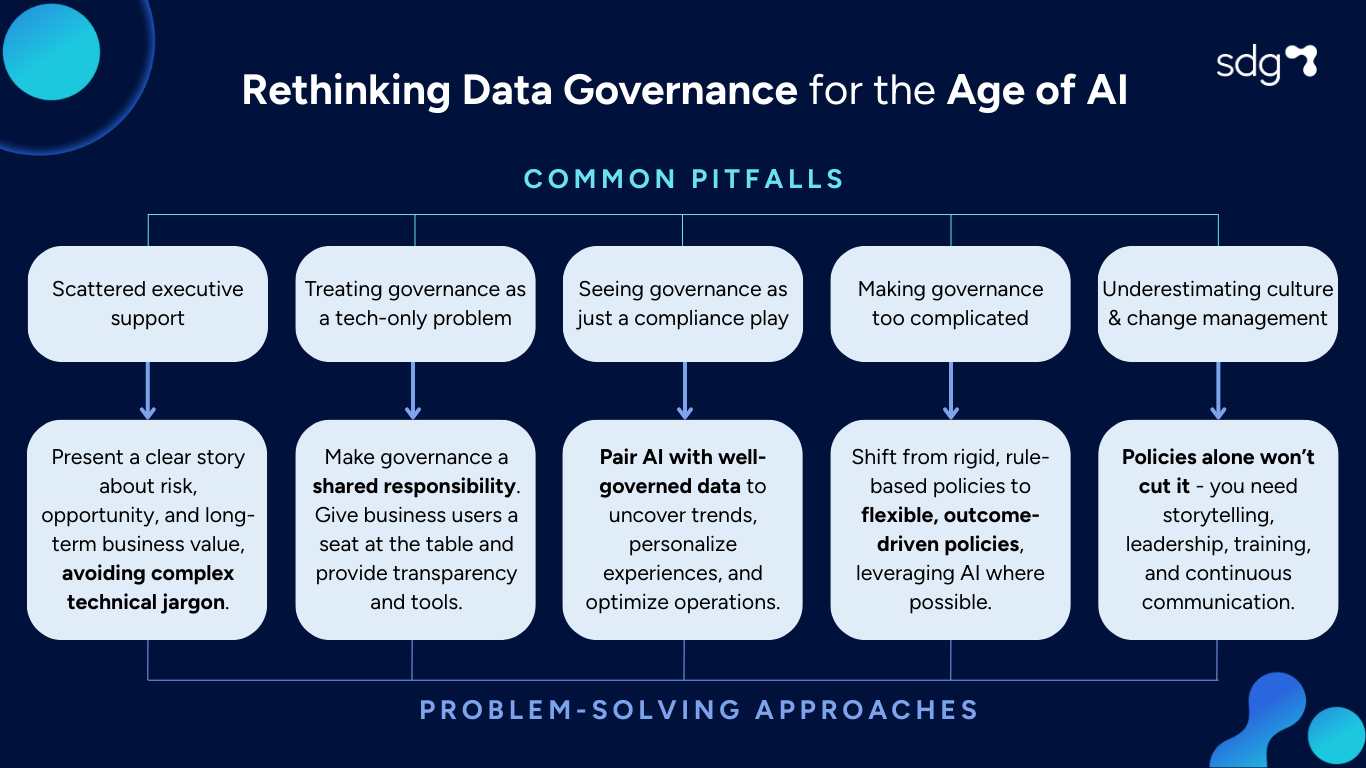
Pitfall #1: Scattered Executive Support
This one comes up a lot.
Data governance can struggle to get the visibility and leadership commitment it deserves. This is a challenge with foundational initiatives, but with AI, the stakes are a lot higher. A poorly governed AI model isn’t just inefficient - it can be biased, non-compliant, or even unethical. The fallout from that can be huge: bad decisions, legal risk, public backlash, and serious brand damage.
AI-related governance challenges - like managing model lifecycles or complying with AI-specific regulations (think EU AI Act) - require more than just operational support. You need leadership that understands what’s at stake and is willing to invest the time and resources in getting it right.
That means making the case to the C-suite not with technical jargon, but with a clear story about risk, opportunity, and long-term business value. Good governance provides the right guardrails to help AI scale. It builds trust. It protects the organization and unlocks innovation. And most importantly, it ensures that AI doesn’t derail before it delivers.
Pitfall #2: Treating Governance as a Tech-Only Problem
Here’s another trap: thinking of data governance as something “owned” by IT.
Yes, technology is a huge part of the puzzle. But governance isn’t just about tools or systems - it’s about people, processes, and decision-making. It’s about getting the data ‘right’ from the business perspective. When governance is handled entirely within IT, business users feel disconnected. They see it as red tape, not something that helps them make better decisions or serve customers more effectively. When AI enters the picture, this gap can widen even more. AI systems are complex and often intimidating to business stakeholders, which makes it even easier to leave governance to the data scientists and engineers.
But that’s exactly the wrong approach.
If we want governance to work, especially in an AI-driven world, we need to bridge the gap. This means:
- Making governance a shared responsibility
- Giving business users a seat at the table
- Providing tools that are actually usable
- Creating transparency into how AI models are making decisions, so people trust the systems they’re working with
Pitfall #3: Seeing Governance as Just a Compliance Play
Compliance is important, no question. But if that’s the only reason your governance program exists, you’re missing the bigger picture.
Strong governance enables faster innovation, improves data quality (which makes AI models more accurate and reliable), and gives teams the confidence to experiment. It ensures that ethical and responsible AI is more than just a talking point, but rather something you can actually get across the finish line.
When AI is paired with well-governed data? The value multiplies. Organizations can leverage AI to uncover trends, predict behavior, personalize experiences, and optimize operations. Your team can move from reactive governance (“Do we have this data, and are we allowed to use it?”) to proactive intelligence (“Here’s how we could combine systems A and B to unlock something entirely new”).
That’s when governance transforms from the safety net to the value driver.
Pitfall #4: Making It Too Complicated
We’ve all seen it: governance policies that are so dense and bureaucratic that no one actually follows them.
As AI enters the picture, things get even more complex. There are new risks to consider, new processes to implement, and new tools to manage. But that doesn’t mean governance has to become a black hole of policy documents and process flows.
In fact, AI can help here, too. Whether it’s monitoring data usage in real time, flagging unusual activity, or keeping policies up to date as things change, modern AI tools and technologies can assist in simplifying and automating processes.
The key is shifting from rigid, rules-based policies to more flexible, outcome-driven ones. Instead of dictating every possible scenario, focus on principles:
- What outcomes are acceptable?
- What risks are we willing to take?
- When should we make exceptions?
- What behavior do we want from our AI systems?
Pitfall #5: Underestimating Culture and Change Management
Finally, the human side of governance is often overlooked - but it’s absolutely critical.
You can design the most efficient governance framework in the world, but if your people don’t understand it or care about it, it won’t stick. This is especially true with AI, where trust is fragile and the pace of change is fast.
To embed governance into the culture, policies alone won’t cut it - you need storytelling, leadership, training, and continuous communication. You also need champions across the organization who can translate governance into everyday language and relevance.
Some roles we’re seeing emerge to support this include:
- Data Literacy Leads
- AI Ethics Officers
- Change Management Leads
- “Data Translators” who connect business and tech teams
You can also use AI to help people learn about governance and AI. Tools like adaptive learning platforms can tailor governance training to different roles and skill levels, making education more engaging and effective.
The Way Forward: Turning Governance Into a Strategic Advantage
So, where does that leave us?
AI changes the governance game. It makes governance more urgent and more complex, but also more powerful. If you approach it with the right mindset, you can turn it from a burden into a strategic advantage. This starts with leadership, but continues affecting the organization through culture. Leadership, and the organization as a whole, must view AI as a partner in building a smarter, faster, more agile governance model.
The organizations that get this right aren’t just checking boxes - they’re building trust, unlocking value, and positioning themselves to win in an AI-driven future. Let’s stop thinking about governance as something that slows us down, and instead start looking at it as the foundational block that helps us scale safely, responsibly, and with purpose.