Supercharge your workflow with zero-click insights from Strategy's HyperIntelligence
Welcome to Tech Station, SDG Group’s hub for uncovering the latest innovations in data and analytics! In this article, we delve into HyperCard, a key feature of the HyperIntelligence suite. Discover how this innovative tool overlays critical business data directly onto your daily applications, from your CRM to your inbox, enabling faster, more informed decisions without ever switching context.
Interested in something else? Find all our content here.
In today’s fast-paced work environment, the speed at which you access the information needed to make decisions can make all the difference.
To address this, Strategy’s Hyperintelligence suite includes a feature called Hypercard, which allows you to view important information—easily, quickly, and in the right context.
In this article, we’ll explore how Hypercard works, why it’s essential for business users, and share a few use cases that may inspire you to adopt it.
What is Hypercard?
HyperCard is a dynamic information card that pops up when users hover over specific data points.
This card can display metrics and insights, enabling users to make informed decisions without the need to navigate away from their current task.
Its greatest strength? It is the ability to be integrated outside of Strategy.
In fact, Hypercard leverages the information contained in Strategy but operates on the main applications used by business users: the feature is compatible with Web browsers (Edge/Chrome), Email clients (Outlook/Gmail), CRM (e.g., Salesforce), and productivity tools (Teams/Slack).
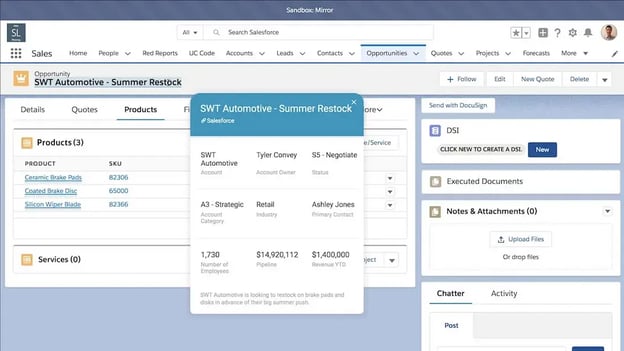
Hypercard on Salesforce CRM
Hypercard’s main characteristics are:
- Contextual Intelligence: HyperCard uses contextual information to surface data that is relevant to the task at hand. For instance, when a user hovers over a sales assistant’s name in their email, HyperCard can provide immediate insights about their performances such as sales trends, customer appreciation score including historical comparisons.
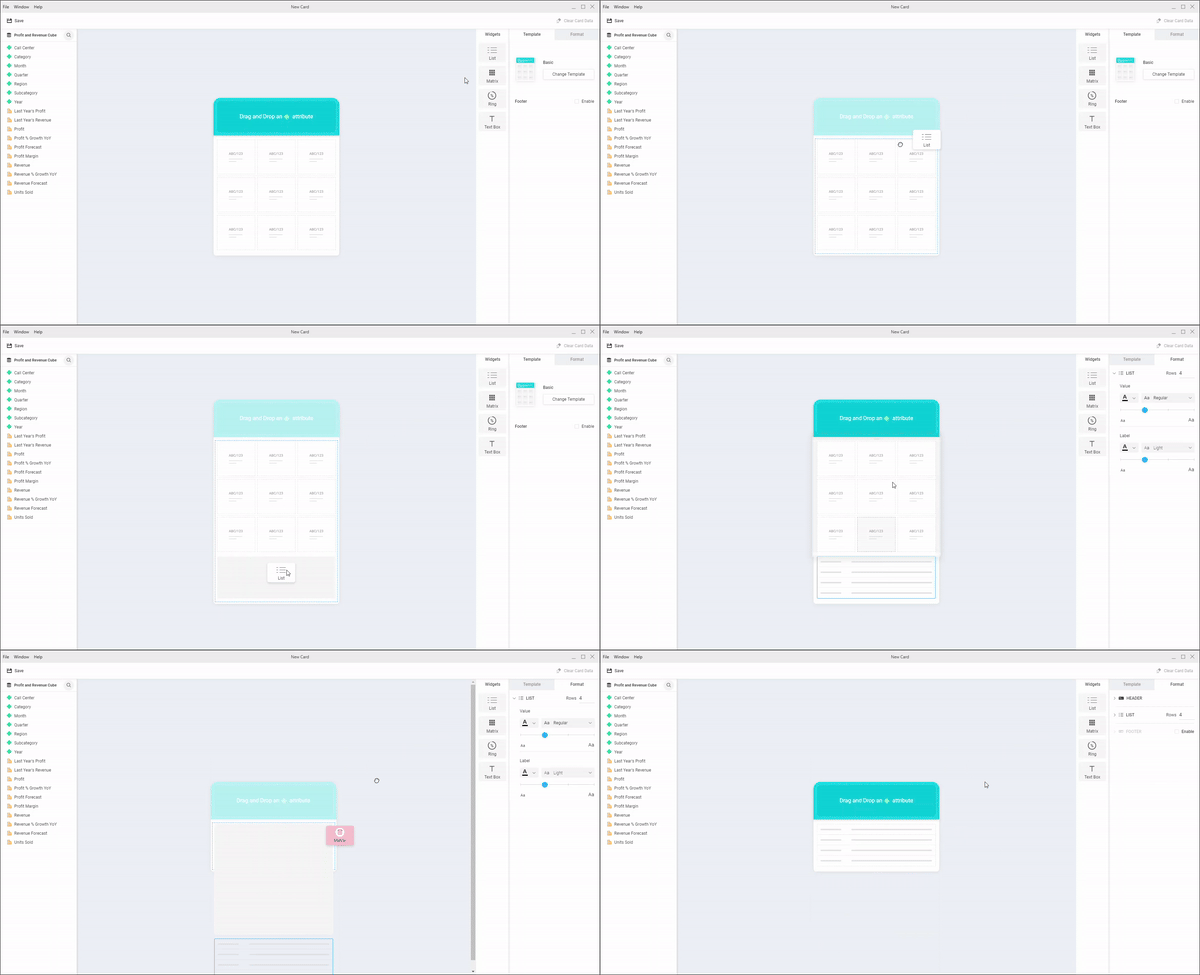
- Low Effort Implementation: Hypercards can be created without extensive technical knowledge. Through a user-friendly interface, users can define the data points to display and the conditions under which the cards will appear. Hypercards are built in Workstation by defining a dataset and drag and dropping components.
- Real-time Data Access: HyperCard connects directly to the organisation’s data sources, ensuring that the information presented is up-to-date.
- Ease of Use: Designed for non-technical users, it enables business professionals to utilise it without needing training.
When building Hypercards, it’s important to keep the following considerations in mind:
- Ensuring Data Quality: the dataset used to build the Hypercard has to be well thought and tested in order to avoid data errors. This is particularly true if you are mixing data from different sources while building for example a summary card.
- Managing Metrics: In a card you can only display metrics without the possibility to analyse them by an attribute. This means that you cannot build a trend analysis as you easily do on a dashboard pulling a time attribute inside a chart. This translates into the need to build metrics that can show the data in the aggregated format you need (i.e. time aggregation such as last quarter, full previous year, quarter to date or filtered values to build a split on specific categories).
- Creating a coordinated layout enhancing UX/UI: Strategy provides enough freedom in layout customisation. Be sure to build a coordinated card with your BI look and feel or alternatively a card that integrates seamlessly with the tool for which it is designed.
Why is it essential for Business Users?
All the features listed above easily translate into key benefits for end users:
- Efficiency: Hypercards can greatly reduce the time spent searching for information while saving time and effort
- Easier Decision-Making: Hypercards show key information at the point of need, facilitating evaluations and considerations
How can your business benefit from Hypercards?
Hypercards, due to their flexible nature, can cover different use cases in different business departments:
- Sales Operations
This tool can be useful for lead management, showing status, latest interactions, or engagement metrics. In parallel, it also proves effective for customer management by quickly providing information on recent purchases, customer classification, and scores. This enables a personalized approach and can lead to better sales performance.
On the other hand a Hypercard can also be useful to monitor Sales Performance on different organization levels giving quick insights for example on specific sales agents or stores or areas.
- Customer Support Agents
Customer Support often needs quick access to customer data to enhance support capabilities. Hypercard can show important data such as satisfaction scores and previous ticket history along with resolution metrics (time and quality of resolution)
- HR
Hypercard can ease employee management providing a summary of employee performance, career path and progression, training history/training to be completed and objectives.
- Supply Chain
it can enable proactive inventory management and improve operational efficiency through an overview of key supply chain metrics such as stock levels and stockout alerts, lead time to replenishment or sales to inventory ratio.
Conclusion
Strategy Hypercard, as part of the Hyperintelligence suite, introduces a fresh approach to business intelligence by delivering the right information, in the right place, at the right time. This not only boosts efficiency but also promotes a data-driven culture across the organisation and simplifies decision-making.
In today’s world of information overload, Hyperintelligence helps you cut through the noise to access exactly what you need—when you need it.
Do you want to accelerate decision-making and bring the right insights, at the right time, directly into your teams' workflow? Contact us for a personalised consultation and discover how the HyperIntelligence suite can transform your data into immediate actions, ensuring operational efficiency, faster decisions, and a real competitive advantage.

